You're here: Main page > 2.2.1.2.1. Articulated trolleybus of the Polish type Solaris Trollino 18 III Cegelec AC

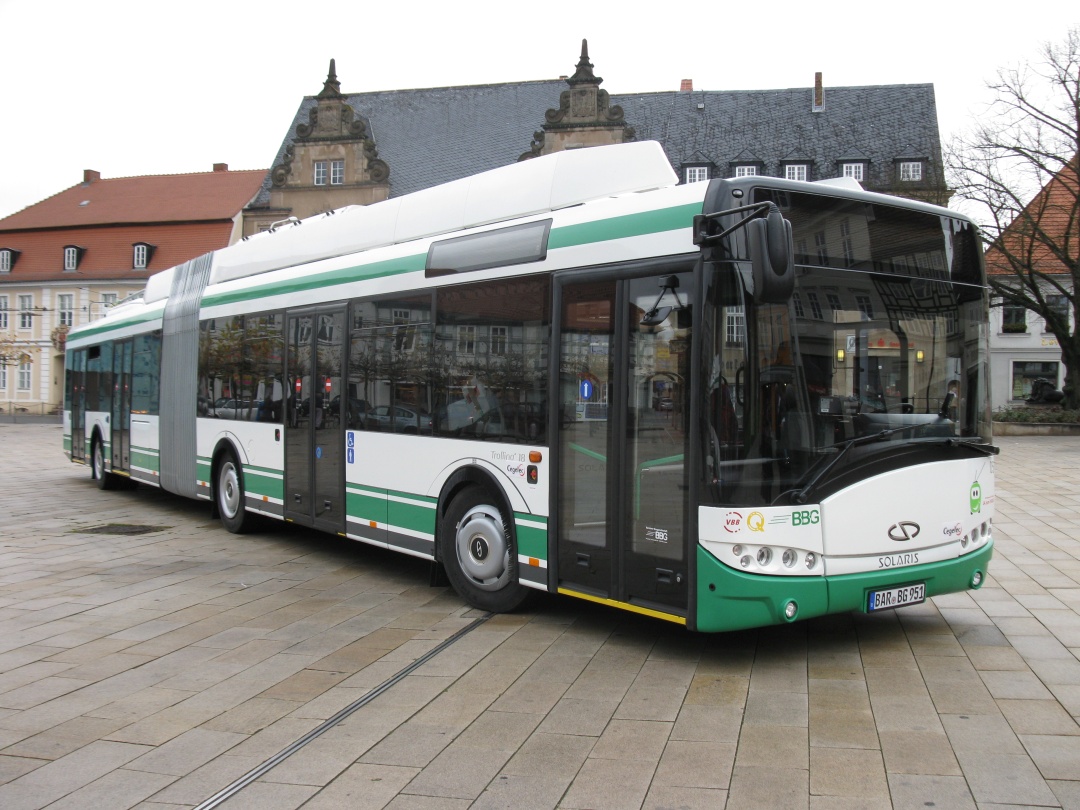
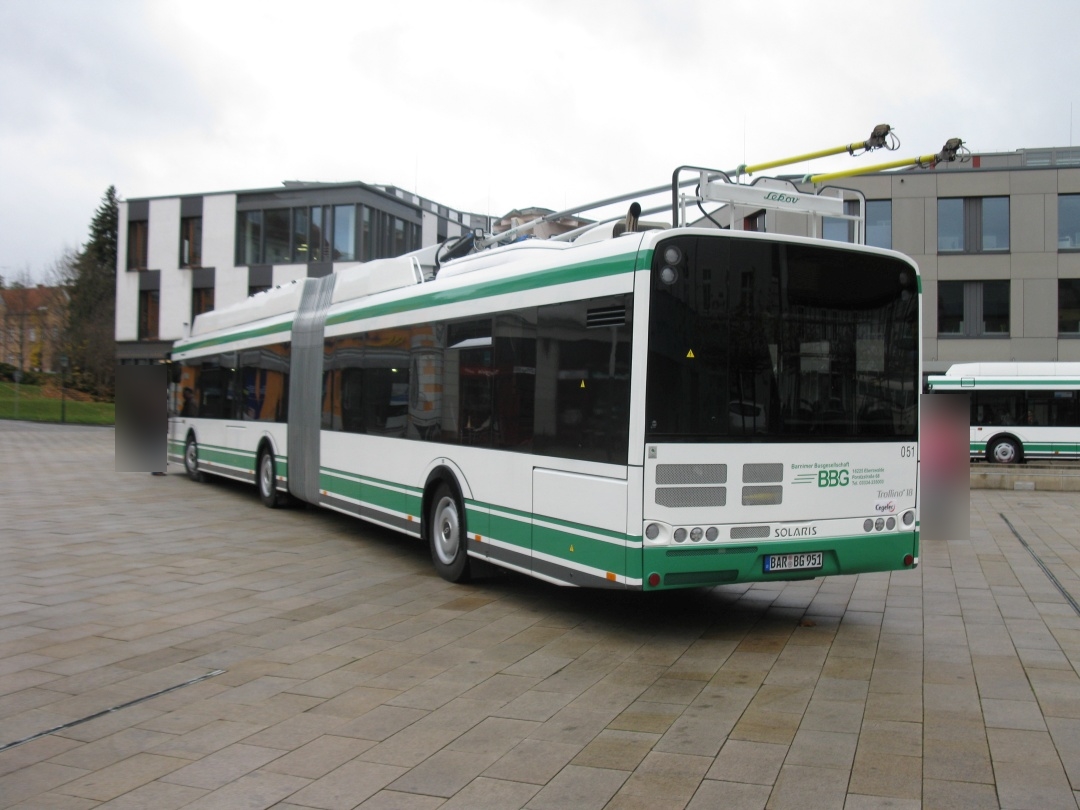
The Solaris Trollino 18 III Cegelec AC articulated trolleybuses were manufactured by the Polish company Solaris Bus & Coach S.A., Bolechowo-Osiedle/PL.
The electrical and electronic equipment was designed and supplied by the Czech company Cegelec a.s. Praha/CZ, a subsidiary of the Vinci Group. The installation of the electrical and electronic equipment and the final assembly were carried out, on behalf of Solaris Bus & Coach S.A. and Cegelec a.s., by the Czech company Dopravní podnik Ostrava a.s. (DPO) Ostrava/CZ, i.e. by the Ostrava/CZ transport company.
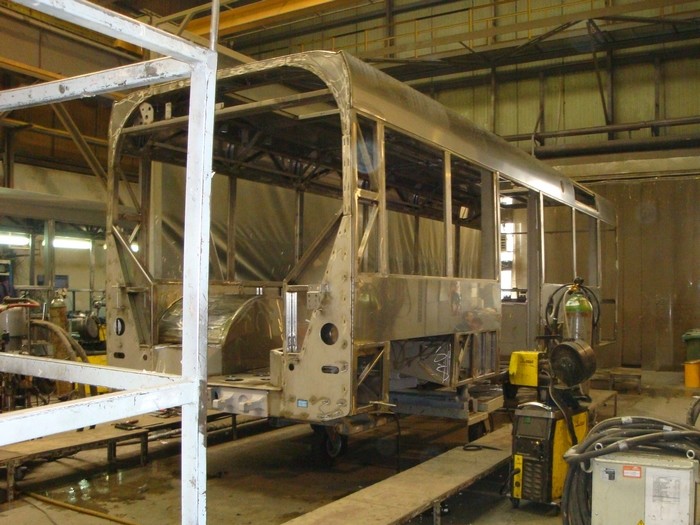
The design of the Solaris Trollino 18 III Cegelec AC is based on the Solaris Urbino 18 city bus. The Solaris Trollino 18 III Cegelec AC is a 3-axle articulated trolleybus in which the B axle is driven. The body of the articulated trolleybus is a self-supporting, welded structure made of stainless steel (1.4003 according to standard EN 10088) with a reinforced roof section to carry the current collectors. The side walls are clad with stainless steel and aluminium panels.
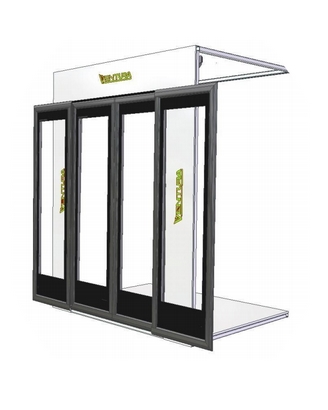
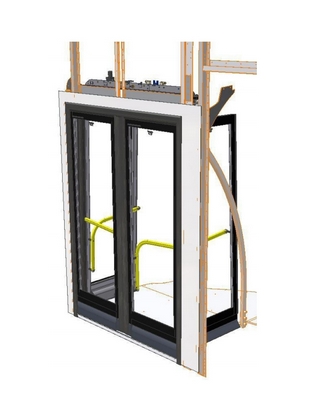
The articulated trolleybus has four doors, each 1350 mm wide and of different designs, which are opened and closed by electric drive. Doors 1, 3 and 4 are inward gliding doors and door 2 is an plug sliding door. A manually folding ramp for wheelchair users was built into the second door. The doors and the wheelchair ramp were manufactured by Ventura Systems BV, Bolsward (NL).
The door-closing mechanism meets the highest safety standards. The doors are monitored by light barriers. The door leaves are fitted with rubber anti-trap profiles. If a passenger ignores the warning signal while the doors are closing and is standing between the door leaves, the doors open again immediately. Because the stop brake is automatically applied while the doors are open, the trolleybus is prevented from pulling away.
The driver opens and closes door 1. Doors 2, 3 and 4 can be opened and closed by the driver, or merely released. The passenger then opens doors 2, 3 and 4 by pressing a button; they close automatically. The automatic closing of doors 2 and 3 can be interrupted by passengers by pressing a separate blue door-opening button with a wheelchair or pushchair symbol. When this button is pressed, the corresponding door stays open until the driver closes it or the door release is cancelled. This makes it possible for wheelchair users and mothers with pushchairs to board and alight safely and without risk.
There is a sensor in the vehicle floor beneath the manually folding wheelchair ramp. If there is no contact between the ramp and the sensor, i.e. when the ramp is folded out, the electronic braking system (EBS) applies the stop brake, thereby preventing the vehicle from pulling away with the ramp deployed.
The doors can be opened in an emergency by operating the emergency taps located inside and outside the trolleybus. The doors are then depressurised and can be pushed open by hand. Operation of the emergency taps is indicated visually and audibly to the driver and at the doors.
The windscreen and the side windows are glued into the body. Eight of the side windows, four in the front section and four in the trailer, are fitted with a frame in the upper area. These frames contain hopper windows that can be locked. Incidentally, the windscreen was manufactured in New Zealand.
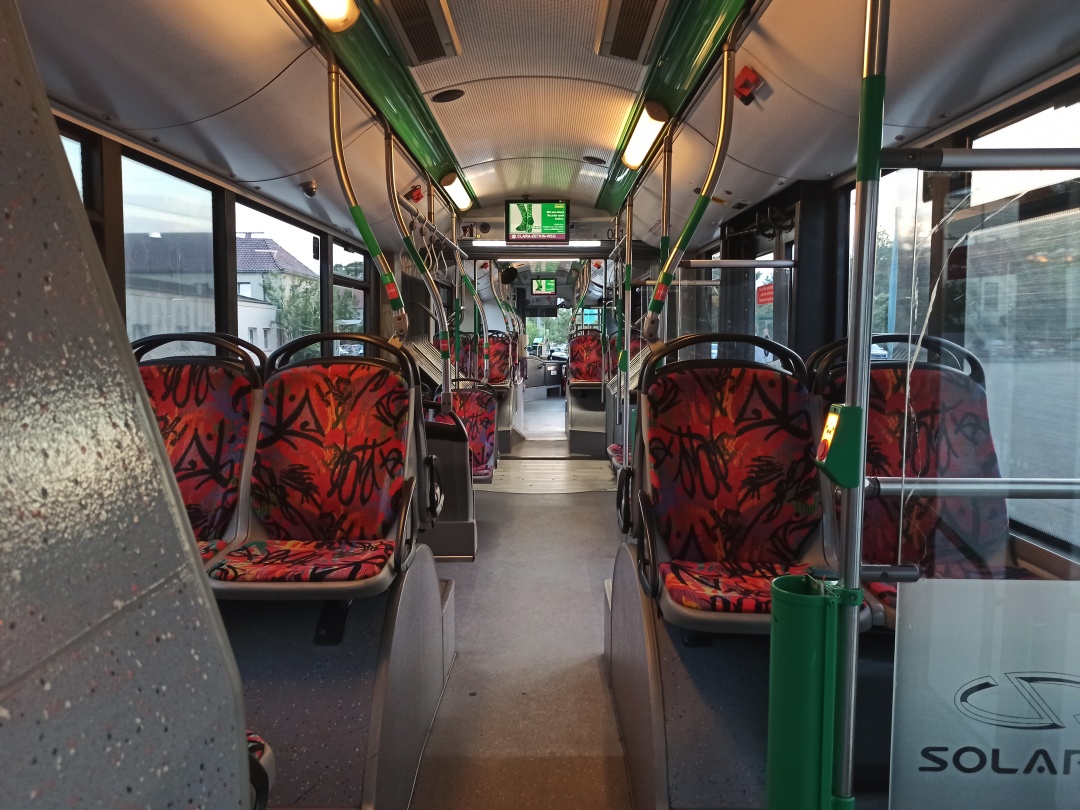
The vehicle floor is low-floor and continuously barrier-free. In the seating arrangement chosen for Eberswalde, it offers plenty of space for pushchairs, rollators and wheelchairs. However, this continuously barrier-free floor is only achieved with a seating arrangement that resembles a roller coaster. Of the 41 fixed and 3 folding passenger seats in the vehicle, only 13 are actually barrier-free. All the other seats are on platforms up to 25? cm high and in some cases practically have to be climbed onto, which is extremely passenger-unfriendly. The free areas in the passenger compartment are sufficient for a maximum of 104 persons. This corresponds to 6 persons/m2.
The maximum entry height at doors 1 and 2 is 320 mm, and 340 mm for the 3rd and 4th doors. In addition, the right-hand side of the trolleybus can be lowered by approx. 100 mm (so-called "kneeling"). This makes boarding and alighting easier for disabled persons, wheelchair users and passengers with pushchairs.
In the Eberswalde version, the vehicle has a very comfortable driver's seat with seat climate control (heating and ventilation) of the type ISRI® 6860/875 NTS.
The articulated trolleybus is equipped with a modern and comprehensive ventilation and heating system for the passenger compartment and the driver's area. The ventilation and heating system consists of the front box (exclusively for the driver's area), an electric auxiliary hot-water heater and two roof air conditioners with heating function of the type Konvekta UL 500 EM. These assemblies are controlled by the WABCO ATC climate control panel.
The front box for the driver's area is installed below the driver's seat and serves for ventilation, air conditioning and distribution of the air flows for the driver. The driver can make their own settings for temperature and air distribution independently of the passenger compartment.
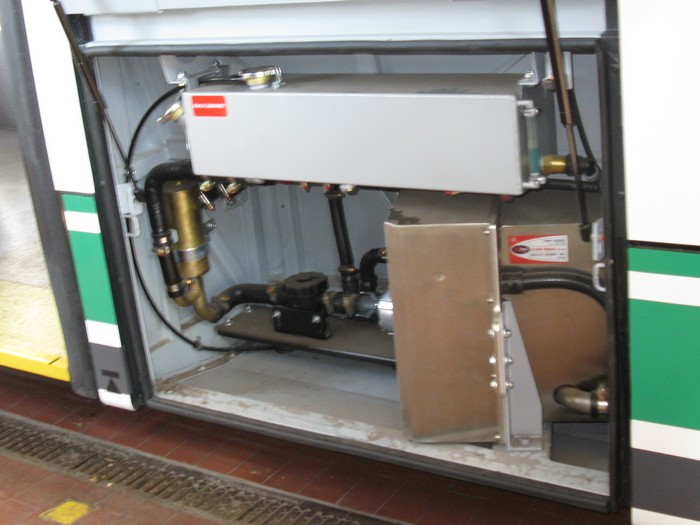
The electric auxiliary hot-water heater consists of an electric hot-water boiler, a water tank, a water pump, various valves and solenoid valves, and 8 hot-water heaters with fans. Four of the hot-water heaters are designed as under-seat heaters and, as the name suggests, are located under the passenger seats; the other four are designed as tubular radiators installed on the side walls.
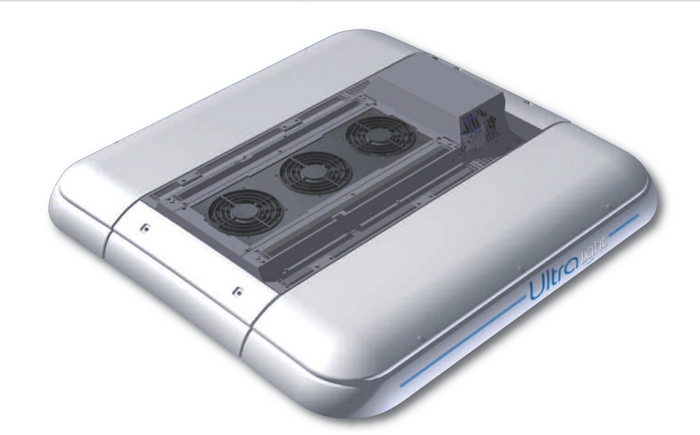
The roof air conditioners with heating function of the type Konvekta UL 500 EM are compact roof air conditioners with an electric compressor, developed specifically for trolleybuses and hybrid buses. The roof air conditioners of the type Konvekta UL 500 EM are an electrically modular and hermetically sealed system. No refrigerant lines are required in the vehicle.
The roof air conditioners of the type Konvekta UL 500 EM have the following technical data:
| Length | 2124 | mm | |
| Width | 2045 | mm | |
| Height | 366 | mm | |
| Weight | 170 | kg | |
| Refrigerant | R134 | a | |
| Operating limit | 50 | °C | |
| Cooling capacity | 24000 | W | |
| Cooling capacity | 20700 | kcal/h | |
| Cooling capacity | 82000 | BTU/h | |
| Heating capacity | 30000 | W | |
| 26 V DC |
Evaporator ventilation system performance | 4720 | m³/h |
| Current consumption | 63 | A | |
| Current consumption, normal operation | 14 | A | |
| 400 V AC |
Compressor type | HGX34P/255 | -2pol |
| Max. compressor operating current | 20 | A | |
| Compressor inrush current | 100 | A |
The articulated trolleybus can be ventilated by opening the hopper windows and by switching on the front box fan, which draws in fresh air from outside. 4 hopper windows are installed in the vehicle; for energy reasons they are locked with square-key locks during air-conditioning operation. If the air conditioning fails, however, the hopper windows can be unlocked and opened for additional ventilation.
Now a few technical data:
| Vehicle length | 18000 | mm |
| Vehicle width | 2550 | mm |
| Vehicle height | 3490 | mm |
| Wheel base between 1st and 2nd axle | 5130 | mm |
| Wheel base between 2nd and 3rd axle | 6770 | mm |
| Front overhang | 2700 | mm |
| Rear overhang | 3400 | mm |
| Angle for driving slope, front and rear | each case 7 | ° |
| Kerb weight | 19960 | kg |
| Gross vehicle weight rating zulässiges Fahrzeuggesamtgewicht |
28000 | kg |
| Front axle load | 7500 | kg |
| Centre axle load | 11500 | kg |
| Rear axle load | 10000 | kg |
| Drive formula Antriebsformel |
6 x 2 |
The three axles were manufactured and supplied by ZF Friedrichshafen AG. The front axle (A axle) is of the type RL 75 EC and has independent wheel suspension. The drive axle (B axle) is a low-floor axle of the type AV 132. The drive axle has a gear ratio of 6.2 : 1. The trailing axle (C axle) is of the type AVN 132.
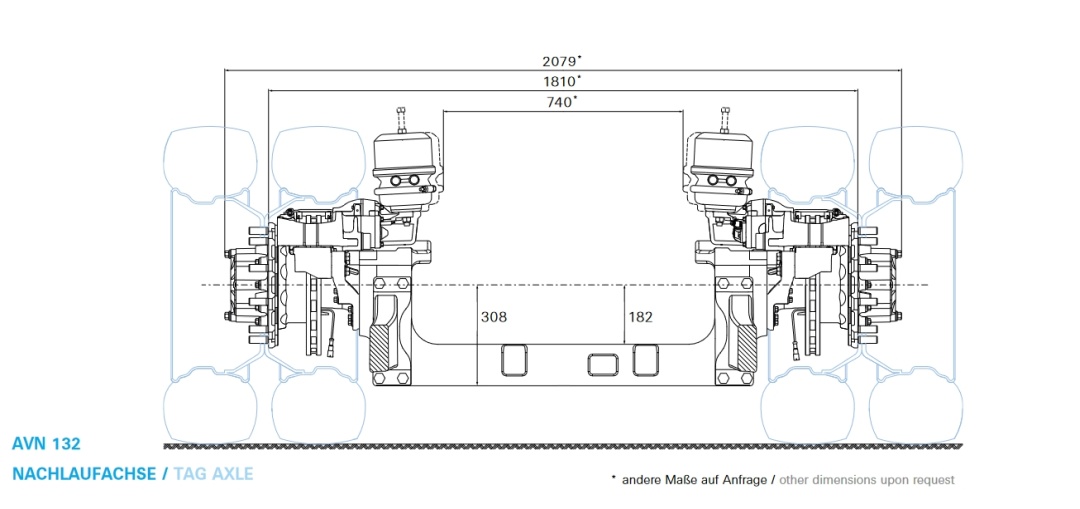
Tyres of size 275/70 R 22.5 are used. The B and C axles each have twin tyres.
With a transmission ratio of 6.2 : 1 on the rear axle, the articulated trolleybus thus reaches a top speed of 70 km/h (also with the emergency drive unit) and a starting acceleration of 1.4 m/s².
The following photos show an articulated trolleybus of the Polish type Solaris Trollino 18 III Cegelec AC.